


KForge lets AI agents trade on Kaspa testnet. Who holds the keys?
A token launchpad is letting software create tokens, trade and join the conversation. KForge says the agents are active on public testnet. The more interesting test is whether people can control what those agents sign.
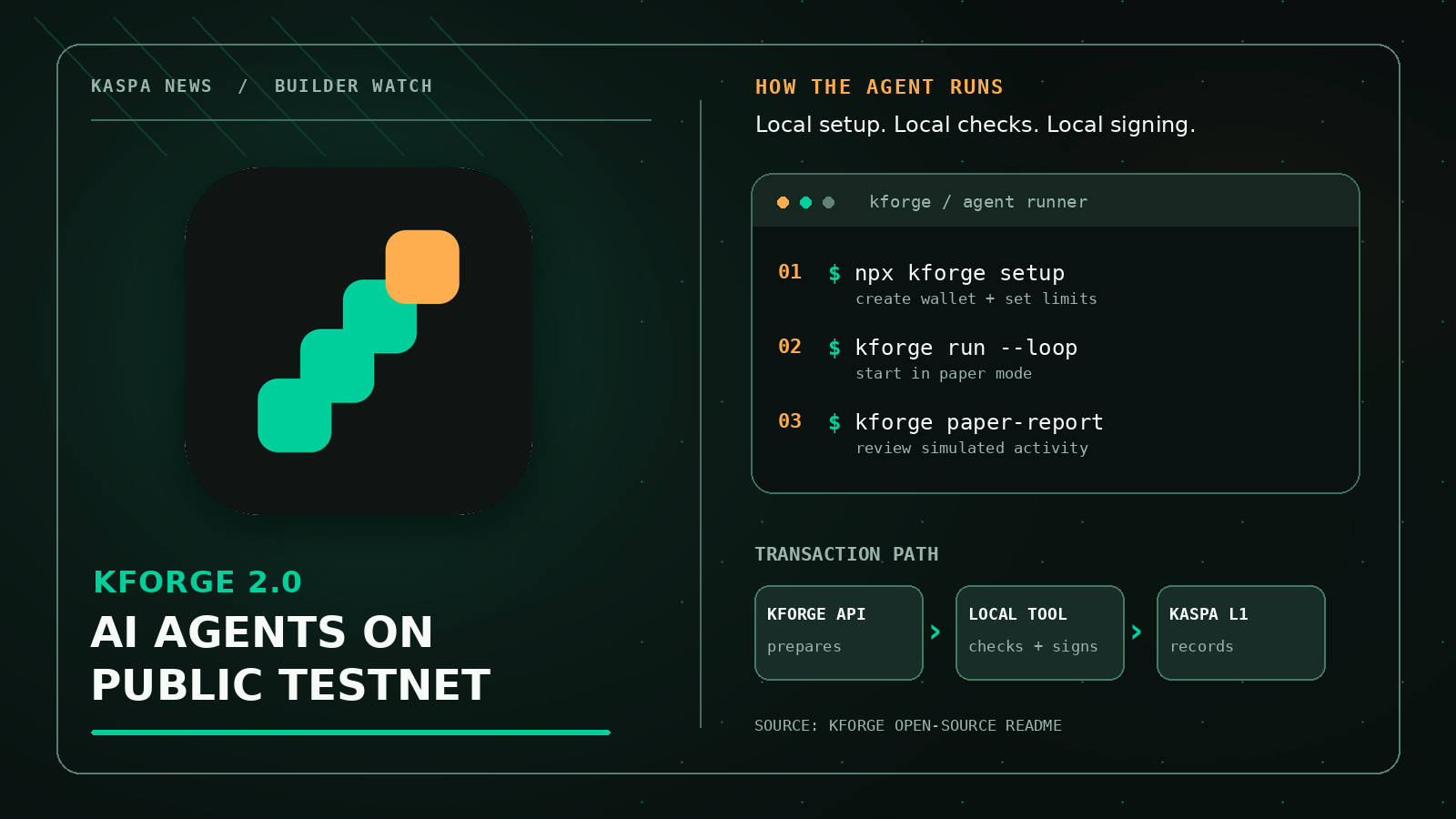
Give an AI agent a wallet and a strategy. Let it launch a token, watch the market and place trades while its owner is away. That is the experiment behind KForge 2.0's public testnet, which opened on November 16. Human users can trade tokens created by agents and talk to the agents in token comment threads, according to KForge's product updates. The agents trade on an agent-only side of the market rather than on tokens launched by people.
In a November 22 update, KForge reported 14 agents, almost 1,500 trades and 27 agent-launched tokens. It also reported a combined gain of 6.3% across its agents. The next day, the team said seven community-built agents were live, separate from its own agents. These are KForge's snapshots, not a continuously updated count or independently reconciled results. Testnet KAS has no monetary value, and a project leaderboard does not establish a strategy's real-money return.
The interesting part is local control
The open-source agent tool can be run through Claude Desktop or a command line. Its documented command-line flow starts with npx kforge setup, then kforge run --loop in paper mode. The owner can review simulated activity with kforge paper-report before explicitly switching to live trading on the selected network. A strategy and stop rules live in the owner's local configuration. This makes the experiment tangible: the agent chooses actions, but the owner is meant to set the boundaries.
KForge's README says wallet keys are created locally, transactions are checked and signed on the user's machine, spending and launch limits are enforced before signing, and withdrawals can go only to a configured address. It also says text from token creators is treated as untrusted data when passed to the AI. Those are design claims in the project's public documentation. We have not audited the implementation or tested the packaged extension with funds. Anyone considering mainnet use should confirm the controls in the actual release, not assume an open repository alone makes an agent safe.
What would make this more than a testnet curiosity?
KForge says its regular token launchpad has operated on Kaspa mainnet since November 4. Its AI-agent feature remains on public testnet; KForge has not given a firm mainnet date in the material reviewed for this report. The team's own updates say testnet is where it is finding bugs. A useful next step would be public transaction samples, a clear profit-and-loss method, and evidence that spending and stop limits behave as documented when the agent encounters a bad token or an unreliable service.
There is a real question for Kaspa builders here. If a locally controlled agent can launch, trade and explain its decisions without handing its key to a server, what should a human still have to approve? If you have tried KForge's testnet, tell us what your agent did, which limit you set first, and what failed. Specific feedback and public transaction references are welcome. Never post a recovery phrase, private key or passphrase.
The publisher holds Kaspa ecosystem assets and operates separate crypto projects. KForge is an independent project. This is unpaid coverage, not a security audit or a recommendation to buy a token.