


Kaspa Dollar puts miners at the heart of its stablecoin plan
A new working whitepaper proposes a dollar token backed by KAS locked on Kaspa L1. Its unusual feature is a price feed built from miners' votes. The protocol is still a plan, and its hardest tests are ahead.
Kaspa has fast native transactions and a growing set of token markets. It does not yet have a live, native, decentralized dollar from the Kaspa Dollar project. That gap is what Kaspa Dollar wants to fill. The project has published a working whitepaper for a KAS-backed dollar token settled on Kaspa's base layer, alongside a fundraising and development roadmap. The roadmap identifies Kaspa core contributor Alexander Säfström, author of KIP-16, as the project lead. The paper says its design is awaiting peer review and may change. Its token is called KSD in the document, but the project says the ticker is not final.
Lock KAS, mint a dollar claim
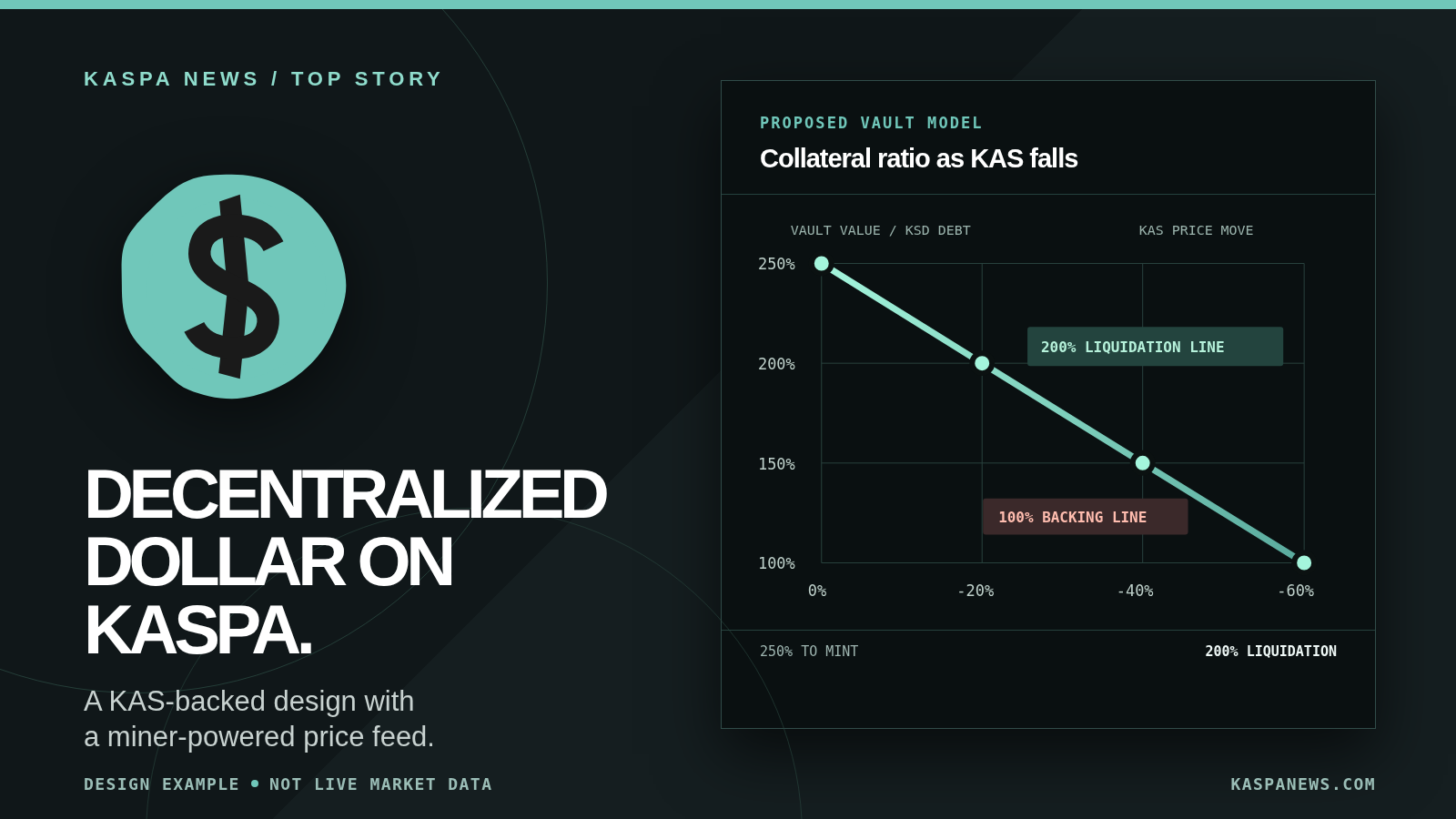
The proposed system starts with a vault. A user locks KAS and can mint dollar-denominated tokens against only part of its value. Under the current draft, opening a vault requires KAS worth at least 250% of the tokens minted. A vault falls to the proposed 200% liquidation threshold if KAS loses 20% of its price from that opening level. Below that threshold, another participant could repay some debt and take KAS from the vault, bringing the remaining position back toward the required ratio. These figures describe the proposed mechanics, not a safety guarantee.
The token's intended dollar peg also depends on redemption. The design would let a holder redeem a token for one dollar's worth of KAS from a vault. If the token traded below a dollar, a buyer could try to buy and redeem it; if it traded above a dollar, a vault owner could try to mint and sell it. Whether that works in practice depends on functioning contracts, accurate prices, active liquidators and enough liquidity to trade. The fundraiser's KAS is for building the system, not collateral backing tokens already in circulation.
Why the miners matter
A collateralized dollar needs a KAS/USD price to decide when a vault may mint, withdraw or be liquidated. Kaspa Dollar's distinctive proposal asks miners to put price votes into the blocks they mine. A prover would aggregate votes from a recent window and submit proof of the median to on-chain price covenants. The whitepaper uses a window of 6,000 blocks, roughly ten minutes at Kaspa's stated rate, and requires votes in at least half the blocks for a valid update. Its design uses Kaspa's sequencing commitments and zero-knowledge verification to check that result rather than trusting a single price publisher.
That is an ambitious way to make the price feed depend on the network itself. It is also a source of risk worth testing. The paper assumes that a majority of voting hashpower reads independent market prices, and it analyzes how concentrated or missing votes could affect the median. If no valid price is posted for 30 minutes, the proposed rules pause price-dependent actions such as minting, withdrawal, liquidation and redemption. Users could still add collateral or repay debt. The parameters are preliminary, and no public audit of a completed mainnet protocol is available yet. The project's mechanics page explains the proposed safeguards and failure cases in more detail.
A roadmap, not a launch date promise
The published roadmap sets a 5 million KAS fundraising target with a January 1, 2027 closing date. It allocates 72% of that target to development, representation and promotion, and 28% to an independent audit. It then targets a testnet system in May 2027, audit and hardening from June through August, and mainnet in September 2027. These are project targets, not completed milestones or guaranteed dates.
Kaspa Dollar says contributions will be refunded under its terms if the fundraising target is missed. The terms treat contributions sent from custodial exchanges differently because the sending address belongs to the custodian, and they explicitly say a refund cannot be guaranteed. Anyone considering a contribution should read the full terms, not assume this is a deposit into a live stablecoin.
The test Kaspa needs to see
A native dollar could give Kaspa applications a unit of account for prices, lending and trading without moving every transaction to a separate network. That is the opportunity. The evidence that will matter next is less glamorous: public code, miner participation, a testnet that handles minting and liquidation under stress, independent audits, wallets that display and redeem the asset, and markets where people can actually use it. A strong whitepaper starts that conversation. It cannot substitute for those results.
What would you want to see first: the miner price feed running on testnet, an independent review of the vault logic, or wallet and exchange integrations? Tell Kaspa News on X. We will follow the build and update the record as milestones are delivered.
Kaspa Dollar is a proposed protocol, not a live stablecoin. Its whitepaper is a working document awaiting peer review. The chart above shows the project's current model and does not show market performance or promise that a future token will hold a dollar peg.