


Michael Sutton sees AI agents writing Kaspa agreements with Argent
Kaspa's covenant upgrade can enforce on-chain rules. Sutton wants agents to be able to express those rules in a language they can compose and inspect. Argent is a promising route, but its own maintainers say it is not ready for general production use.
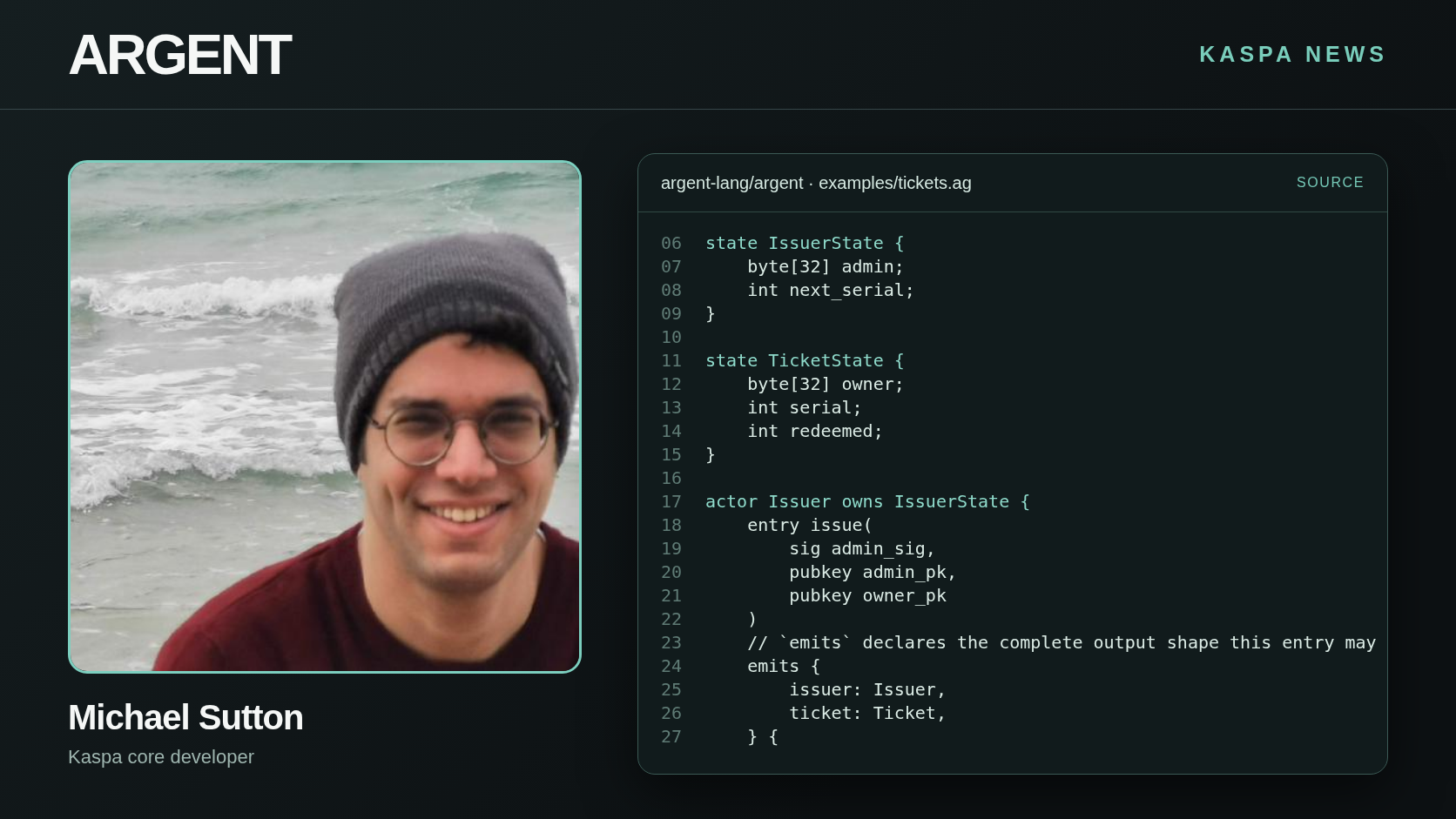
Michael Sutton is making a specific bet about the next wave of on-chain software: AI agents will need more than a fast payment rail. In a September 23 post, the Kaspa core developer argued that agents need a language for creating rules with one another, plus a way for several parties to enter an agreement in a single transaction. His example is a temporary job in which unfamiliar agents agree on contributions, success conditions and payment before work begins.
Argent is the language and compiler Sutton is building toward that vision. A developer writes an application as actors with typed state and permitted transitions. Argent then generates Silverscript contracts and a portable artifact that its runtime uses to assemble the transaction. Kaspa's native script engine, not an added virtual machine, checks the resulting covenant rules when the transaction is spent.
What the agent would actually do
Imagine one agent asking two others to complete a research task. They could propose a rule that locks payment until specified parties approve the result. Argent's proposed role is to express the participating contracts and how their states change together. If the application is correctly designed and deployed, Kaspa's covenant rules would enforce the valid transitions. The agents would still need off-chain software to negotiate, hold keys, sign transactions and decide whether the work met the agreed terms. The compiler cannot judge the quality of a research report.
The distinction matters. Argent's use of the word actor describes a state-owning covenant object, not an AI model. Its agent-named example is a contract example, not proof that autonomous AI systems are transacting on mainnet.
The live rail and the unfinished layer
Kaspa's Toccata upgrade activated native L1 covenants on June 30. Kaspa's developer documentation describes that programmable base as live while calling Argent an evolving stack. Argent's repository says its compiler, runtime and end-to-end examples are functional. It also says the project is not release-ready and needs further audit and hardening. Its release page showed no published release when we checked on October 28.
That makes the market-share claim a forecast, not a result. There is no public evidence yet that Argent has attracted substantial AI-agent usage or shifted activity from other networks. The test will be more concrete: a tagged release, reproducible and reviewed contract builds, documented agent applications, and real transactions whose rules users can inspect. Sutton's idea has a clear technical path. Adoption is still to be earned.